like Facebook follow Twitter watch YouTube subscribe RSS Feed
Tag Archives | honeylove

California Dearth Conditions

via HoneyLover Susan Rudnicki

Beeks—As you are probably reading everywhere, California is in the middle of a extended drought and this significantly affects the available food—pollen and nectar—for our bees. People can get a false sense of security about this problem since all around are extensive irrigated landscapes— golf courses, industrial parks, shopping malls with fountains and lush landscaping, apartment and condo blocks, and private homes.

However, all this is carried out by the importation of precious water from underground aquifers and water resources channeled from the middle and northern part of the state. Irrigation with re-claimed sewer water—-designated by the required violet colored pipes and valve box covers—is still a anomaly, unfortunately. Our streets are still running with rivers of wasted water, too.

For a simple tabulation of the history of the rainfall pattern, go here: http://www.laalmanac.com/weather/we13.htm

You will see, since 2000, we have been much under normal 8 years and only in excess 5 years—and not that much in excess, when the average for 135 years is only 15 inches. The population of California is projected to be 60 million by 2050, from the 34 million counted in 2007. The water is not going to be there to sustain this many people in the lifestyle currently practiced.

Many beeks are noticing their bees have small stores of honey, or sometimes, nothing. I am seeing cutouts with lots of brood, but almost NO honey/nectar stores. As beekeepers, this is important for us to monitor when doing inspections of our hives and when trying to support small nucs and cutouts after the trauma of the operations when we move them. We may need to feed our bees to help them manage the loss of available food supply—called a “dearth” –if we wish for them to be around for us come Spring. The best food for bees is their natural food—honey. This can be provided by frames of honey taken from strong hives. “junk comb” from cutouts, and honey purchased for the specific feeding purpose. A bee has a natural acidic pH in her gut that is supported by many strains of bacteria, fungi, and other microbes adapted to that pH environment. When we feed sugar or high fructose corn syrup, the more alkaline nature of these sugars alters the gut pH. Some scientists believe this is not beneficial to the gut microbes that serve the bee’s immune system. However, if the situation is one of the choice between starvation or feeding sugar, we may need to feed the sugar syrup to get by until there is a natural nectar flow.


Big thank you to Susan for contributing to our blog as well as moderating the HoneyLove Forum!

Read full story · Posted in Newsletter Articles

BEEHIVE HEROES

Paul Hekimian inspects a honeycomb forming in one of the hives behind his home

Paul Hekimian inspects a honeycomb forming in one of the hives behind his home (via argonautnews.com)

Backyard beekeepers work to save the local honeybee population from collapse

Story by Rebecca Kuzins via argonautnews.com

Most people who discover a beehive in their backyard would be glad to see it gone.

Paul Hekimian is not like most people.

After discovering a hive in an avocado tree behind his Santa Monica home in 2012, Hekimian — with help from Del Rey beekeeper Rob McFarland — moved the bees into brooding boxes, which provide ideal conditions for a hive. Since then, he has been raising honeybees, extracting and bottling honey, and even adopting more bees by rescuing swarms that have gathered at places such as Tongva Park and the Santa Monica Pier.

Hekimian is part of a new breed of urban beekeepers who’ve developed organic, pesticide- and chemical-free techniques to raise smaller hives with more disease-resistant honeybees. But the way Hekimian tells it, he just sets up his brooding boxes and then leaves the bees alone so they can produce honeycombs — and more bees.

“At the end of the day, the bees do all the work,” said Hekimian, a father of two young boys who also has his hands full running both a wholesale bakery and a technology consulting business. “You’ve heard the phrase ‘busy as a bee.’ These bees are very busy.”

Hekimian’s work and that of other backyard beekeepers is more than just a hobby. It’s also an environmentally minded response to the colony collapse disorder that has plagued honeybees for almost a decade and threatens the very future of agricultural and natural ecosystems.

Save the bees, save ourselves

In 2006, beekeepers began noticing that many worker bees had abandoned their hives, resulting in a loss of one-third of the nation’s honeybees. Since then, bees have continued to disappear, with scientists and researchers citing several possible reasons for the loss. Some argue that a fungus or virus is responsible, or that the bees have died from poor nutrition or parasites. More recently, numerous articles in scientific journals maintain a specific group of pesticides is the cause of the problem.

The sudden and rapid decline of the bee population has gotten the attention of President Barack Obama, who had two hives installed at the White House garden this summer — making him the nation’s most high-profile urban beekeeper.

In June, Obama created a Pollinator Task Force to establish a federal strategy aimed at promoting the health of honeybees and other pollinators.

“Honeybee pollination alone adds more than $15 billion in value to agricultural crops each year in the United States,” reads a statement announcing the task force. “Severe yearly declines create concern that bee colony losses could reach a point from which the commercial pollination industry would not be able to adequately recover.”

Or, as Hekimian says it: “If the bees go, they’re taking us with them. One in three pieces of food is touched by bees.”

Already struggling with drought, California’s almond industry also relies on bees for pollination. Bees also play a significant role in pollinating strawberries, watermelon, broccoli, squash and myriad other agricultural and other plants.

Some cities have responded to colony collapse disorder by legalizing beekeeping on private property, and the Santa Monica City Council adopted such an ordinance in 2011.

“The city council recognized bees are a very important link in the food chain,” said Dean Kubani, director of the city’s Office of Sustainability and the Environment. “Bees play so many important roles in the production of fruit and vegetables and most of what we eat. … I think in the past, there was a fear that bees in urban and suburban areas would harm people. That has shown not to be the case.”

The fight to legalize bees in L.A.

The Los Angeles City Council has been studying how the city could adopt its own backyard beekeeping ordinance since February. Some Los Angeles residents, like Rob and Chelsea McFarland, are already keeping bees. Founders of the nonprofit organization Honey Love, the couple has conducted an extensive neighborhood outreach and lobbying campaign in favor of a bee-positive city ordinance.

Chelsea McFarland said she and her husband made the decision to become beekeepers after a swarm showed up in the backyard of their Del Rey home.

“We have an organic garden and we knew about [colony collapse disorder]. We knew the bees were in trouble,” she said.

When the McFarlands contacted the city for advice about handling the swarm, they were told “the only thing to do was exterminate [them],” she recalled. “That’s still the case. Part of the [city’s] policy should be not only to legalize [beekeeping] … but to try and rescue rather than exterminate.”

Sylvia Henry is also a Los Angeles beekeeper and Honey Love member. She started keeping honeybees in March after Hekimian brought a swarm to her Mar Vista home, where her hive shares space in the backyard with eight chickens. “I’m an old farm girl,” Henry said. “I grew up on a farm in Chino.”

Henry said she is “thrilled” with her hive, which has already produced 30 pounds of honey. She’s “read all of the books in the library on bees” and is fascinated by the “whole entire cycle” of beekeeping and the “social set-up” of honeybees.

Not far from Henry’s backyard, another group of bees live on the roof of Louie’s of Mar Vista, a popular neighborhood restaurant and bar on Grand Avenue south of Venice Boulevard.

John Atkinson and his wife Laura opened the restaurant last year at the site where his grandfather, Bill Atkinson, and Bill’s buddy Louie operated a butcher shop from 1954 to 1969.

While renovating the property, John Atkinson noticed a swarm of bees had gathered inside a large sign above the building.

“Rather than poison them, we got them out of the sign and cut off access for them to get back into the sign,” he recalled.

The bees were placed in hive boxes on the restaurant’s roof, and Atkinson hired a beekeeper to take care of them. Over the past year, the population of what the restaurant’s website calls “Mar Vista’s bees” has increased threefold.

Louie’s of Mar Vista uses honey from these hives in some of its dishes and to create its signature Bee Sting cocktail — a combination of applejack brandy, ginger beer, lemon and honey, served with a slice of lime and a mix of sugar and ginger around the rim of the glass.

“It’s not like having a goldfish”

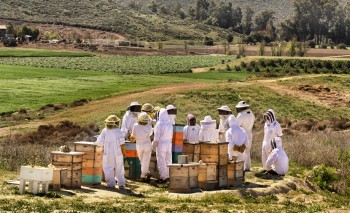
As part of its education and support mission, HoneyLove conducts monthly seminars, including some at its bee sanctuary in Moorpark, to train backyard beekeepers.

“It’s not like having a goldfish,” Chelsea McFarland said. “You definitely want to know what you’re doing.”

Hekimian, on the HoneyLove board of directors, agrees that wanna-be beekeepers need training before they can graduate to get a beehive.

Beekeeping, Hekimian adds, is the art of observation: “You watch the behavior of the bees as they go in and out the front door. Are they going out? Are they bringing in pollen?”

Beekeeping comes fairly naturally to Hekimian. His father, Kevork G. Hekimian, kept bees when Paul was growing up in Houston.

“My dad started out with a couple of hives and then had 60 hives,” he said. “I got him back into beekeeping,”  Hekimian said of his father. “It’s come full circle.”


[read the full article via argonautnews.com]

Read full story · Posted in HoneyLove Buzz, HoneyLove Interviews

Keeping honeybees! Sounds like fun?

LA Weekly frame
by Susan Rudnicki

So much is in the news about pollinator declines,  peril to the food supply, pesticide poisoning of honeybees—could we not help this situation by keeping our own bees?  HoneyLove exists to foster this very practice, and all of us in the group were mentored and brought along our path to becoming beekeepers by others in the craft.  In fact, this model is the very essence of our  club—“each one teach one” or “pay it forward” to help others learn.

But, there are important things to consider when contemplating the serious commitment of beginning a life of bees and beekeeping.

Probably the most important part is to become educated by reading and speaking to knowledgeable beeks about the management techniques and time commitments involved in keeping bees in a urban environment.   Getting the bees and buying equipment  comes later, but a person should honestly assess whether there is the time in life to —

1) do hive inspections every two weeks in the Spring season when bee colonies are rapidly growing in population.   Bee colonies that become crowded from lack of space management can swarm and this attracts very unwelcome attention from non-beekeeping neighbors.

2)  keep up during the whole year to assess honey production, brood space (where the bees raise the young larva), queen vigor and other issues.   Later in the Summer, inspections can be spread further apart—about a month.

3)  be realistic about getting a honey crop.   The colony, when young, must be given time to grow in strength and resilience.   The first year of a young colony, there is NO honey crop.   The second year, you may get a bit.   By the third year, they hit their stride and you can have a fine honey crop!   (This is my experience, anyway)

4)  spend the time necessary to consistently learn the techniques and understanding of how “bee society” works.   We must always keep in mind that honeybees are stinging insects and the wider public often has a well developed fear of them.   How we manage our bees and speak to others about bees goes a long way towards changing perceptions and biases—or, if lax in management and monitoring, how we may reinforce prejudices.   It is up to us to present our best “face” of the beekeeping world.

5)  develop a mentor relationship with at least one other knowledgable beek.   This takes digging, because there are not enough of us, geographically speaking!   HoneyLove conducts meetings every month, has apiary visits to the bee sanctuary in Moorpark, and has lots of material on the website to guide newbees in gaining wisdom.

6)  coming to HoneyLove gatherings and workshops gives the new beek a chance to interact with folks all along the spectrum of knowledge and to ask questions and network for further connections.

If these considerations seem a little burdensome for right now, it may not be the right time to actually get your own colony of bees.   It is a time commitment and must be managed regularly.   Perhaps just fostering the local bees with planting of inviting flowers and shrubs is a better plan.

Joining the HoneyLove forum to explore these options with others is a great way to figure out if you are indeed ready to keep bees!

Read full story · Posted in HoneyLovin

BEES KNEES art exhibition in St. Louis

ATTN: ST. LOUIS HONEYLOVERS <3!!!

July 19th Alexi Era Gallery is throwing a BEES KNEES art exhibition at their gallery where 100% of the proceeds go to HoneyLove!! Beautiful honey bee inspired postcards, honey tasting, wine and food! There will also be 10 larger art pieces posted online for the rest of us to bid on!

Check it out here: https://www.facebook.com/events/710777705630253/

Read full story · Posted in HoneyLovin

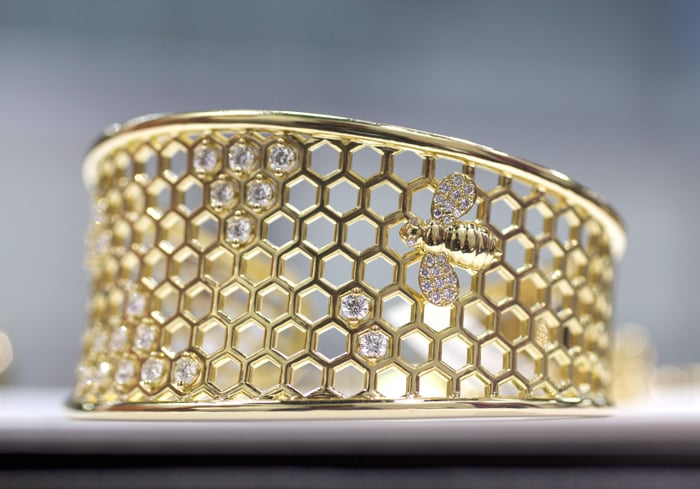
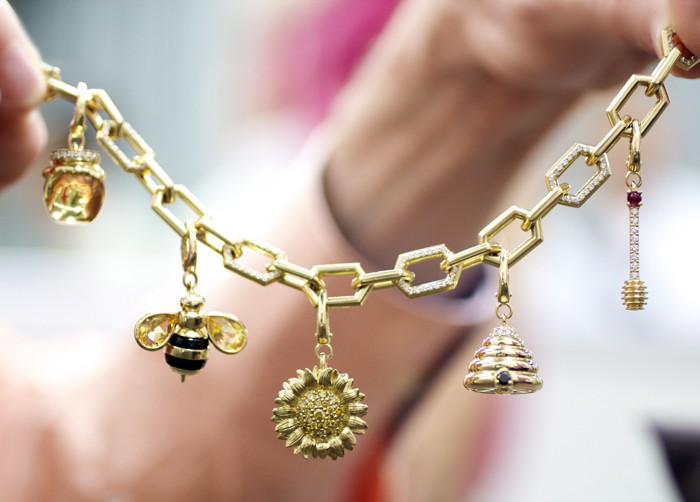
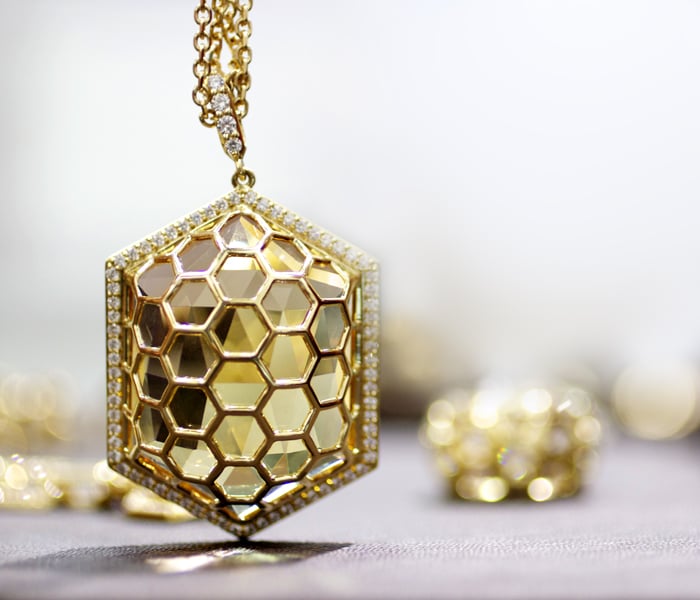
Gumuchian “B” Collection benefits HoneyLove!

Check out Gumuchian “B” Collection!!
A portion of the proceeds of all sales will go to HoneyLove.org! 

Press Release: http://www.gumuchian.com/files/b-collection-pressrelease.pdf


Photography courtesy of Erika Winters from Pricescope

[via pricescope]

Did you know that the declining honeybee population is affecting the world’s food supply? We didn’t. And we also didn’t know that one in every three bites of food consumed in the U.S. is a direct or indirect result of bee pollination. According to HoneyLove.org, bees pollinate a whopping 80% of the world’s plants. 

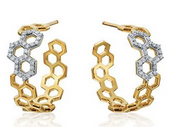
So Patricia Gumuchian–who designed the “B” collection of rings, bracelets, earrings, and necklaces–answered the call to action to support urban beekeeping.

“I have never been afraid of bees. I think they’re wonderful,” said Patricia Gumuchian. “I look around our office of women and think about the worker bees – who are the female bees – and how valuable they are to our livelihood. Our family gatherings and holidays largely center on all types of foods. What would happen if these things just went away? The effects could be detrimental. We need to change what’s going on.”

gumuchian

View more press on the collection below! 

http://www.cijintl.com/

http://jewelrynewsnetwork.blogspot.com/

http://instoremag.com/

http://www.jckonline.com/

http://americangemsocietyblog.org/

http://blog.nationaljeweler.com/

http://www.jckonline.com/

http://news.centurionjewelry.com/

http://www.pricescope.com/

http://www.epageflip.net/   Page 28

http://www.jckonline.com/

http://www.jewelsdujour.com/

Read full story · Posted in HoneyLove Buzz

VOTE FOR HONEYLOVE!

We are thrilled to announce that HONEYLOVE was chosen as a finalist of the “Communities with Drive” program, sponsored by Zipcar, Inc. and Ford Motor Company.  Communities with Drive is designed to acknowledge and reward organizations that are having a profound impact on the communities in which they operate.

As one of 25 finalists from over 400 entries, HoneyLove is eligible to win $50,000 in cash as well as $15,450 in Zipcar credit to support the organization’s needs. Here’s where you come in: winners are voted on by the public at
http://on.fb.me/1jwsmxR

vote-button

We would LOVE for you to spread the buzz that HoneyLove is a finalist to increase our chances of receiving the substantial prize in order to continue to best serve the beekeeping community.

If you are a supporter of HoneyLove, we sincerely hope you will increase our chances of winning this impactful prize by voting for us. For additional information please check out: http://bit.ly/1m9cCzx.

Many Thanks—YAY BEES!!

And… bonus points for buzzing about it on twitter: @iheartbees @Zipcar @ Ford #CommunitiesWithDrive

Read full story · Posted in HoneyLove Buzz, HoneyLove HQ

Los Angeles in June

via Susan Rudnicki

honeylove-10a_Snapseed

BEEks —we are going into high summer, and if all health is good in your colonies and the brood nest has been managed successfully to prevent swarms, you should be able to harvest honey from hives 2 years and older. Note the age—new hives, from this Spring or Winter are needing you to let them keep their stores for building up.

We are in a strong drought of three years duration, so if you live near the foothills and your bees must rely on lots of natives for pollen and nectar, they may be finding the pickings slim. You may need to feed them. Only inspection and conferring with other knowledgeable beeks will help you determine this. Please utilize the great opportunity HoneyLove offers as a networking resource by attending our educational meetings and events and using the Forum to advance your confidence by posing questions. Beekeeping is a extended learning curve craft with lots of nuances.

photo by rebeccacabage.com

Stay up on your inspection schedule (every 2 – 3 weeks)  and keeping records of when you do them, what you see, and what you think your observations portend for the colony.  Drone brood frames discovered in the brood nest can be moved up to the top box and after the drones hatch, this area is often filled with honey.

Keep  your ant control barriers in good order for young hives, weak hives, or recently hived swarms, cutouts or trap-outs. They NEED this cheap, easy and effective insurance from you.

Please take the time to be observant of all the flowering trees, shrubs, and annual flowers that your bees use for their food.  Eucalyptus, Mellaleucas, Grevilleas, Grewia and many others  are blooming now—we should strive to know these plants and their bloom cycles to truly know our bees.

Read full story · Posted in HoneyLove HQ, Yay Bees

PODCAST: Michael Bush on Treatment Free Beekeeping

Podcast via kiwimana

Michael Bush
Treatment Free Beekeeper / Author and Speaker from Nebraska
WEBSITE: http://www.bushfarms.com/bees.htm
BOOK: “The Practical Beekeeper: Beekeeping Naturally” http://goo.gl/1l747d

Want more? Watch the HoneyLove video interviews with Michael Bush below!

AND! Please click below to subscribe to HoneyLove on YouTube!!
youtube subscribe

Read full story · Posted in News, Yay Bees

Yellow Tie Event 2014 Recap!

Big thanks to all who sponsored, donated, volunteered and attended!

Special shout out to Whole Foods Market, Plaza El Segundo for the FOOD, Jack Daniel’s Tennessee Honey for the DRINKS, LUSH Cosmetics for donating and VOLUNTEERING, and the Loo Family for HOSTING!

Read full story · Posted in HoneyLovin

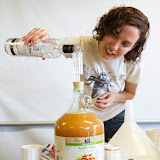
Hard Apple Cider Workshop

Thanks so much to everyone who came out to HoneyLove’s Hard Apple Cider Workshop last weekend!

Click below to view some photos from the workshop!

Photos by Karim Sahli

Click here to download the workshop handout via dropbox!

Read full story · Posted in HoneyLove HQ, HoneyLove Workshops