Thanks so much to everyone who came out to HoneyLove’s Hard Apple Cider Workshop last weekend!
Click below to view some photos from the workshop!
 |
| Photos by Karim Sahli |
 Urban Beekeepers
 follow
  watch
watch  subscribe
Thanks so much to everyone who came out to HoneyLove’s Hard Apple Cider Workshop last weekend!
Click below to view some photos from the workshop!
|
| Photos by Karim Sahli |
Click here to subscribe to HoneyLove on YouTube!!
Our goal is to get 10,000 subscribers by this year’s NATIONAL HONEY BEE DAY (August 2014)—Please help us spread the word by sharing this link: honeylove.org/subscribe
Join us for Yellow Carpet photos, great food, fun drinks, local honey tasting, and a special musical performance in support of HoneyLove’s mission to protect honeybees and inspire and educate new urban beekeepers!
DATE: May 18th, 2014 (4-7pm)
LOCATION: 3939 Villa Costera, Malibu, CA
Meetup: http://www.meetup.com/HoneyLove/events/124416092/
Facebook: https://www.facebook.com/events/747615325251741/
Learn more: http://honeylove.org/yellow-tie-event/
Click the flyer below to download a full resolution copy!

ORDER YOUR TICKETS to the YELLOW TIE EVENT below:

THIS WEEK ONLY: FLOAT.org Apparel is donating $8 from every purchase to HoneyLove
Pick up an Urban Honey Tee this week and help the HoneyLove protect the health and well-being of honeybees! $8 from your purchase will be donated to HoneyLove.
Get a 10% off coupon code here – http://floatapparel.refr.cc/L4DVD8R
10 different shirt styles!!
Shirts printed on 93% combed & ring-spun cotton/7% polyester using eco-friendly, water-based inks.
CLICK HERE TO GET ONE BEFORE THE SALE ENDS!!


Login and vote for HoneyLove HERE!
Click the little blue “It’s Good!” triangle on their site!
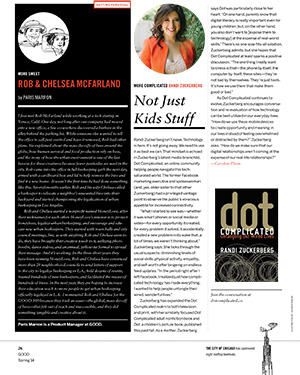
Bee colonies are vital to our food supply, but they have been dying off for nearly a decade. CBS News’ Ben Tracy reports on the rise of urban beekeeping, and the push in Los Angeles for a “pro-bee” ordinance to officially allow beekeeping.

If you are interested in the mysterious task of rearing queens perhaps you would like to join Les Crowder and OneStrongHive for a TWO DAY WORKSHOP! We will do some first hand queen cup making, grafting and all that bringing these precious gals into being entails.
This will be a two day workshop on Saturday and Sunday the 8th and 9th of March, from 10:00 AM – 4:30 PM each day.
The price for the 2 day workshop is $130 and it will take place in Silver Lake, California. Payment can be made in advance with PayPal (payments to: oramomi@gmail.com) or you can pay with cash or check at the workshop in person.
RSVP
Facebook: https://www.facebook.com/events/675162239191982/
Meetup: http://www.meetup.com/HoneyLove/events/165698232/

Queen Rearing Workshop
by Saul Gonzalez [KCRW]
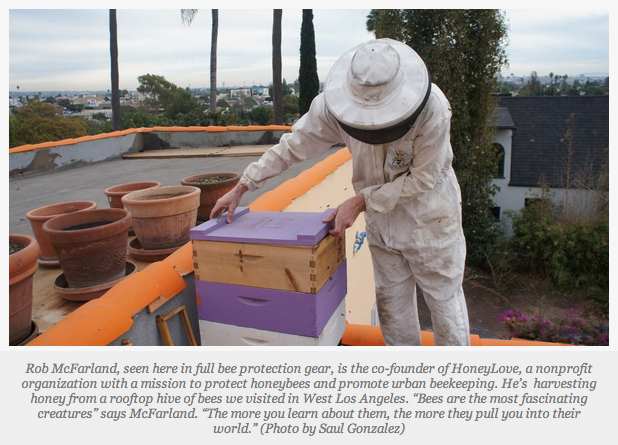
“In many parts of the world honeybees are in trouble, with their populations in sharp decline. That decline has scientists, environmentalists, farmers and bee lovers worried because of the bees/ importance to pollination and, thus, agriculture.
But there’s some good news: here in Los Angeles the wild bee population is thriving, with as many as a dozen hives per square mile in some neighborhoods. And where there are bees there are beekeepers. L.A. has a surprisingly big community of urban beekeepers who have backyard hives. These urban beekeepers are motivated both by their love of straight, fresh-from-the-hive honey and a desire to do something to help save the global bee population.
However, when it comes to municipal rules and regulations, urban beekeeping in the City of L.A. isn’t explicitly legal. Urban beekeeping advocates, led by a group called HoneyLove, are trying to change that. They’d like to see the city adopt rules and regulations that both promote urban beekeeping and safeguard wild bee hives reported by the public.”
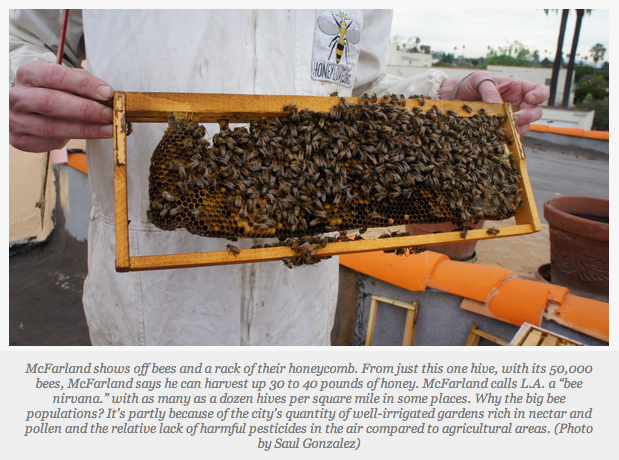
View full article:
http://blogs.kcrw.com/whichwayla/2014/01/making-la-a-bee-friendly-city
CLICK BELOW TO SUBSCRIBE TO OUR MONTHLY NEWSLETTER!
http://goo.gl/QZxZ3W
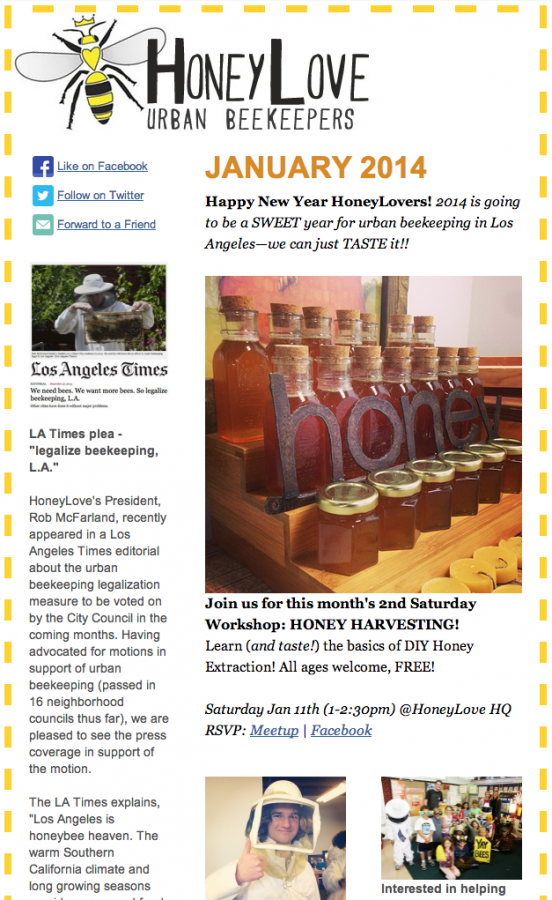
View full newsletter here: http://us5.campaign-archive1.com/?u=bd28d4b1ae114be68c43384ee&id=ac76a82563
By The Times editorial board—December 27, 2013
Los Angeles is honeybee heaven. The warm Southern California climate and long growing seasons provide year-round food for bees. The city’s trees, flowers and flora are largely free of pesticides. It’s the perfect place for backyard beekeeping — except that beekeeping is not legal here.
That could soon change. A group of bee advocates and neighborhood councils has been lobbying the City Council to expressly allow beekeeping on single-family residential lots. Current law permits it only in areas zoned for agriculture. Next month, the City Council will decide whether to move forward with legalized beekeeping.
There’s a good reason to allow it. Commercially raised bees used to pollinate crops are disappearing in big numbers because of what’s known as colony collapse disorder, but nobody knows what’s causing the problem. Urban honeybees may end up replenishing the diminishing supply, or providing disease-resistant genes that can be introduced in the commercial bee lines.
Los Angeles should follow the lead of other major cities and draft rules that allow residents to keep bees, while providing some common-sense protections for neighbors. There’s already an established backyard beekeeping community in Los Angeles despite the fact that it is not legal. The growing urban agriculture movement has spurred more interest in homegrown hives (in part because the bees are needed to pollinate the new urban crops) and more confusion over what is and isn’t allowed.
New York City allowed illicit apiarists to come out of the shadows in 2010, and since then hobbyists have established hives on building roofs and in backyards. The city set basic rules: Colonies must be in well-maintained, movable frame hives with a constant water source, in a location that doesn’t pose a nuisance. Beekeepers file a one-page hive registration form with the city health department each year.
Santa Monica permitted beekeeping in 2011 with similar requirements. Residents are allowed two hives per backyard, and the hives must be at least five feet from the property lines. Apiarists who don’t follow the rules or who let their hives become a nuisance to neighbors face fines or misdemeanor charges.
Both cities said they’ve had no major problems; beekeepers have largely followed the rules or moved their hives in response to complaints. And city officials said there’s been a benefit: a larger network of amateur beekeepers to call upon to remove swarms rather than exterminate them.
There will understandably be some concern and fear from neighbors — a swarm of feral honeybees can look like something out of a horror movie. Beekeeping experts say there are already lots of naturally occurring, unmanaged hives in the region. A managed hive in which bees have adequate food and space is less likely to produce a swarm.
We need bees. We want more bees. It’s time to legalize beekeeping.
[view original article via latimes.com]
 We at HoneyLove believe that the city is the last refuge of the honeybee. Our home gardens are generally free of pesticides, and in cities like Los Angeles, there is year-round availability of pollen and nectar for the honeybees!
 Become a member of HoneyLove and learn to be an urban beekeeper!
 Plant an organic garden without the pesticides that harm honeybees!
 Provide a water source on your property – bees love clean water to drink!
