like Facebook follow Twitter watch YouTube subscribe RSS Feed

About Chelsea McFarland

Author Archive | Chelsea McFarland

LISTEN: Natural Beekeeper Kirk Anderson via @rootsimple

Root Simple’s interview with Kirk Anderson, a natural, no-treatment beekeeper and mentor. Kirk tells funny stories and shares his wisdom on how to keep bees in a big city. During the podcast they discuss:

[click here to view podcast on Root Simple]

Read full story · Posted in HoneyLove Interviews

READ: Organic Beekeeping Conference in Oracle Arizona

Oracle_2015_2

By HoneyLover Susan Rudnicki

One of the most delightful and informative ways beeks can advance their understanding of bees and beekeeping is by attending conferences. The American Beekeeping Federation conference was held in Anaheim this year in January and I went to several presentations. This was a completely academic conference, combined with a large trade show—no live bees to work with. This group also reflects a strong conventional management and commercial pollinator representation. There are always things to be learned though, and I found the time well spent.

However, a number of smaller and more appropriate conferences for us treatment free folk also occur every year. The 8th Annual Organic Beekeeping conference at Oracle AZ, put on by Dee Lusby allows participants to visit the 9 bee yards kept by Dee in the remote Sonora desert near the Mexican border. These bees are never moved (no migratory pollination) are at least 4 deeps tall, are not re-queened or supported with any feeds, and are visited (on average) just 5 times a year. Dee’s honey is very dry and dark, reflecting the dry climate and mixed desert flora the bees have for forage. These flowers include many desert shrubs, cactus, wildflowers, and introduced weed species too numerous to mention. The Spring rains this year have been abundant and well spaced, so we saw lots of wildflower and cactus blooms. The desert smelled wonderful—fresh, sage-y scented with alternating bright blue skies and looming smokey thunderclouds.

Oracle_2015_1

Rob McFarland (Co-Founder of HoneyLove) and I drove to Oracle, which is in a very remote area. The conference is sited at the YMCA, with cabins and bunk beds for sleeping and 3 full cafeteria meals a day. Some of the best time is spent at meals in talking with other bee keepers from all over the US and even other parts of the world.

The conference lasts 3 days, with speakers on a range of subjects—apitherapy (using bee stings for health reasons), introduction of a new national on-line register for swarm calls to beekeepers, the beekeeping management calendar year from a extreme climate perspective, and new information on genetics and breeding of queens. Michael Bush and Sam Comfort, our great friends in treatment free beekeeping not only spoke individually, but on the last night gave us a melodious, heartfelt performance for almost a hour. Michael plays guitar and sings, Sam plays ukelele and banjo and a MEAN harmonica!! It was stupendous and had people’s roaring approval.

Our final day was devoted to driving on dirt roads to Dee’s remote beeyards—she has 700 hives. The day was a bit windy and cold, with threatening rain, but we went anyway, and the desert was glorious with color. The desert bees were very ferocious in defending their colonies, reflecting the weather and forage conditions they must deal with. We were fully suited and gloved to help restore some hives that were tipping wildly from the undermining of the bottom board by tunneling rodents. The hives had to be totally unstacked, the bottom board leveled and supported by fresh soil and the hives re-stacked—each at least 4 deeps.

I urge all that wish to really know beekeeping and infuse the relationship with new knowledge to attend these bee conferences.

Read full story · Posted in HoneyLove Workshops, Yay Bees

READ: Should LA legalize urban beekeeping?

by Dr. Noah Wilson-Rich

LA is the only major city in the United States with illegal beekeeping.

City planners must remain forward-thinking. California is a huge agricultural state. To make any pollinators illegal is to limit agriculture. That decreases job availability, limits food production, and prevents access to education. These are social justice issues, and policy makers must take action to allow access to these resource for all residents. In 100 years, is it possible that we could have modern, urban farms on rooftops or underutilized properties? It is, if policy allows it so. Our population is growing, but our available land is not. We must be smart about how we plan for the future of urban living. We must legalize pollination, and honey bees are the best generalist pollinator available to humans… Furthermore, corporate real estate companies are rolling out regional and national beekeeping programs to increase their sustainability image. Beehives can even help make skyscrapers more sustainable and earn an additional LEED certification point by the Council for Green Buildings.

Will legalizing beekeeping increase the number of swarms in the city?

Beekeepers play a vitally important role in preventing disease and preventing swarming. My 2014 TEDxBoston talk (above) showed how beekeepers work with municipalities to develop programs to collect any swarms rapidly, and perhaps more importantly, open access to education about how to prevent them. When New York legalized beekeeping in 2010, there was no influx of honey bees as pests to anyone. A person walking through Times Square today would have no idea that there are multiple hives overhead at the InterContinental Hotel. Managed beehives swarm far less frequently than feral hives because beekeepers add space to the hives as they grow. Space is a trigger of swarming, as the queen bee continues to lay eggs, the population of a beehive runs out of space, and some of that population must leave to go find a new home. Beekeepers prevent swarming by using standard, safe beekeeping practices to keep bees in their hives and not in people’s chimneys, sheds, or walls. This is a non-issue in Boston, New York, Paris, and anywhere else urban beekeeping has been successfully happening for a long time.

Will supporting urban beekeeping damage our native bee population?

Many native bees pollinate in different ways than honey bees do. For example, bumble bees use sonication, or buzz pollination, whereas honey bees do not. Carpenter bees drill holes in the sides of flowers and take resources through a different mechanism. Honey bees can collect pollen left by those other mechanisms and make use of it, but honey bees do not compete with those bees because of different pollination mechanisms. There is plenty of pollen and nectar to go around and be shared by all bees. See my book (The Bee: A Natural History, published in 2014 by Princeton University Press) for more information about urban beekeeping, including about how the diversity of bee species is relatively the same between ground level and rooftop habitats. Bees live in harmony – these are non-aggressive, vegan, garden pollinators. I, too, fully support native bee conservation, as well as pollinator conservation as the larger issue. My book addresses all 20,000 or so species of bees, to prove this.

Are bees still in trouble?

The 2014 Farm Bill provides reimbursement for Beekeepers who experience greater than 17.5% loss of beehives. The national average remains between 30-40% loss of beehives each year, and this is in the post-CCD world (see my Sept. 2014 piece in the New York Times). Bees are dying from myriad diseases for which there is no cure, and data published in the most recent Science magazine and highlighted in BBC show that there are host jumps to other bee species, specifically to bumble bees as Mark Brown and colleagues showed. Bees do best in urban environments, and so we must allow bees to live in habitats where they are thriving. This is of vital importance for our future in urban living, where we will have more and more people to feed from less and less land.

Policy makers need to vote in favor of urban beekeeping and not prevent access to jobs, affordable food, healthy food (fruits and vegetables), and education.


The Best Bees Company is now offering our beekeeping services in and around Los Angeles. Our proceeds fund our research to improve bee health. One of our current research studies is investigating urban beekeeping, comparing honey production and hive health in cities compared to the countryside. We are currently seeking special permissions to set up observational research hives in Los Angeles to provide local data, but our multiple emails to LA policy makers have remain unanswered. For more information about getting beehives, scheduling a complementary site consultation, bee research, speaking events, or hiring local beekeepers, please contact us at INFO@BESTBEES.COM or (617) 407-8979.

Dr. Noah Wilson-Rich is the Founder & Chief Scientific Officer of The Best Bees Company, a beekeeping service and research organization based in Boston’s South End. His research is based at the Urban Beekeeping Lab & Bee Sanctuary, where he and his team develops experimental treatments for improving the health of honey bees. In 2012, Dr. Wilson-Rich gave a Ted talk about urban beekeeping. His first book. “The Bee: A Natural History” will be published in 2014 by Princeton University Press (US) and Ivy Press Ltd. (UK).

Read full story · Posted in HoneyLove Interviews, Newsletter Articles, Yay Bees

NEW! LA County Apiary Registration Forms

LINK TO FORMS: https://www.dropbox.com/sh/5tr9ljcy5zsapkw/AAAHSuE3fqpAlDAgLFF7Lzgwa?dl=0 Paul Hekimian inspects a honeycomb forming in one of the hives behind his home

Read full story · Posted in Uncategorized

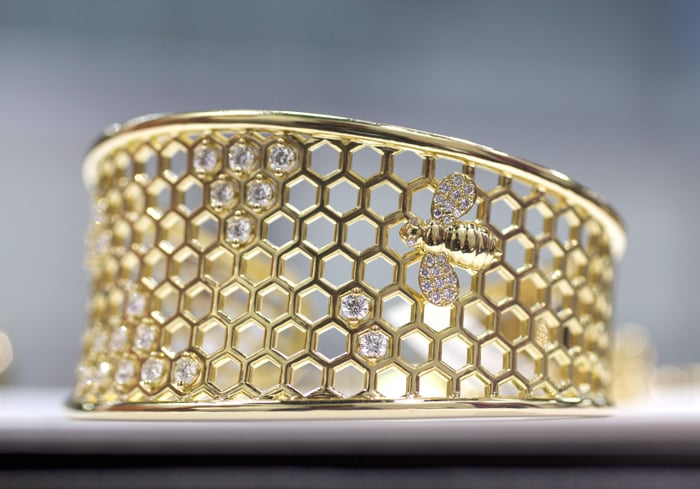
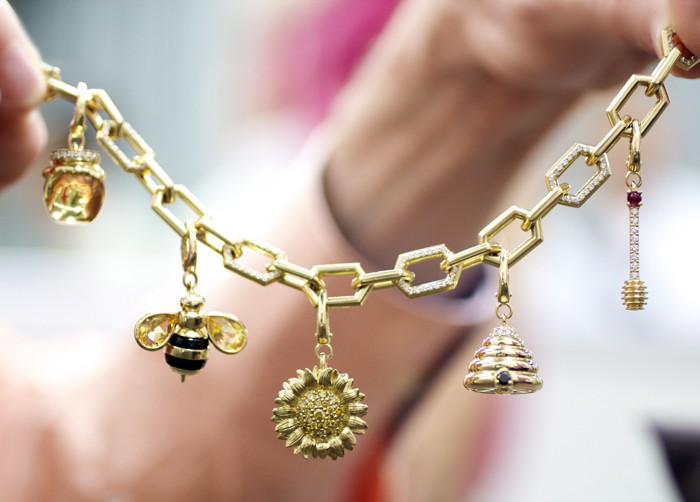
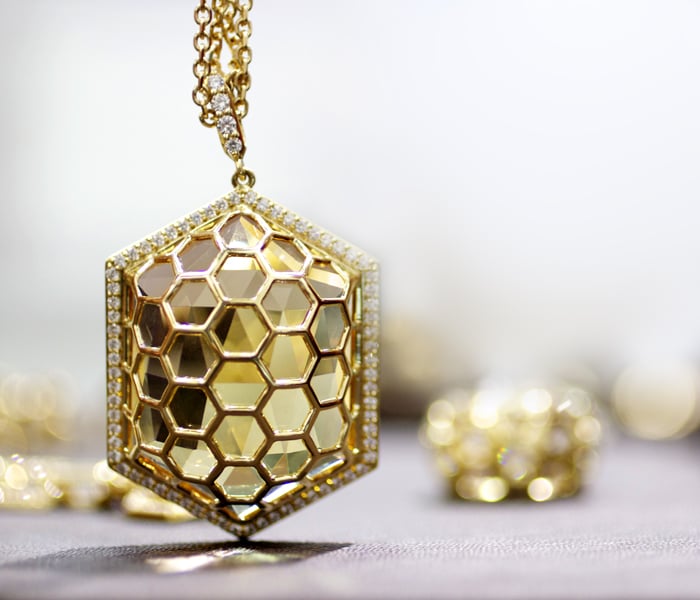
Gumuchian “B” Collection—Buzz

Check out all the buzz about Gumuchian “B” Collection!!
A portion of the proceeds of all sales will go to HoneyLove.org!


Photography courtesy of Erika Winters from Pricescope

PRESS:

http://obsessedbyjewelry.com/celebrate-national-honey-bee-day-gumuchian-jewelry-cause/

http://www.cijintl.com/In_The_Press-6076.html

http://jewelrynewsnetwork.blogspot.com/2014/05/gumuchians-jewelry-is-for-bees.html

http://instoremag.com/homepage/shine-news/13854-new-gumuchian-collection-highlights-bees

http://jogsshow.com/gem-jewelry-news/honor-black-yellow-friends/

http://www.jckonline.com/blogs/style-360/2014/05/16/debuting-in-las-vegas-gumuchians-b-collection-bee-theme-gold-jewelry?utm_source=JCK%20eNewsletters&utm_campaign=61b72045d4-2014_05_16_Fashion_Friday&utm_medium=email&utm_term=0_56301e74d4-61b72045d4-333952953

http://americangemsocietyblog.org/2014/06/14/jewelry-with-a-cause-gumuchian-creates-awareness-for-honeylove/

http://blog.sina.com.cn/s/blog_988dcd240101irgg.html

http://adornmentality.com/2014/05/28/jewelry-week-in-sin-city-who-you-should-see-part-3-jck/

http://www.pricescope.com/blog/whats-buzz-gumuchians-new-b-collection-stunned-jck-2014

http://blog.nationaljeweler.com/2014/05/the-baubles-and-the-bees.html

http://www.jckonline.com/2014/07/15/gold-bee-inspired-jewels-and-silicone-supported-bangles

http://news.centurionjewelry.com/articles/view/brand-news-from-gumuchian-frederic-sage-forevermark-and-precision-set

http://www.epageflip.net/i/359465   Page 28

http://www.jckonline.com/blogs/on-your-market/2014/08/05/britts-pick-gumuchians-b-honeycomb-medallion-pendant

http://www.jewelsdujour.com/2014/05/the-bees-knees-gumuchian-b-collection/

http://obsessedbyjewelry.com/celebrate-national-honey-bee-day-gumuchian-jewelry-cause/

Read full story · Posted in HoneyLove Buzz

LOS ANGELES LEGALIZATION UPDATE!!

Public Hearing Notice: Backyard Beekeeping Draft Ordinance

All interested persons are invited to attend a public hearing for a proposed City of Los Angeles Zoning Code amendment to allow backyard beekeeping in single-family residential zones. At the hearing, you may listen, speak, or submit written information related to the proposed ordinance. This is the first in a series of public hearings regarding this proposed ordinance as it moves on to the City Planning Commission, Planning and Land Use Management committee of the City Council, and City Council.

PLACE: Los Angeles City Hall, Room 1010, 10th Floor – 200 N. Spring St, Los Angeles, CA 90012
TIME: Thursday, March 19, 2015 at 2:00 pm

Please see the link below to the public hearing notice, Q&A and draft ordinance for more information.
http://goo.gl/gpZHWQ 

For more information, please contact staff:
Katie Peterson
KATHERINE.PETERSON@LACITY.ORG
213-978-1445

Read full story · Posted in News

Bee Informed Partnership Hive Scale Project

Susan BIP Scale
via HoneyLover Susan RudnickiHave you ever wondered how our local, LA Urban beekeeping differ from other areas of the country? I just read the other day that beekeepers in Wales expect about 25 pounds of honey per year on their hives—33 pounds is a bumper crop!   This does not seem like much. Our bees are active year ’round, making brood, honey and drones. This growth is very different from temperate climate bees and, as well, we are using Africanized hybrid ferals—a relatively rare population to survey. We now have a opportunity to participate in amassing data on our specific niche by the generosity of HoneyLove who purchased the SolutionBee Hive scale for me to monitor a hive in my backyard garden.

The project is managed by BIP (the Bee Informed Partnership)  and the hive data is automatically sent to their website as well as the SolutionBee team, the manufacturers of the hive scale (purchased from Brushy Mountain). The colony I selected came from a large swarm hived on April 27, 2014 which has proven to be super productive and nicely behaved. They now occupy 3 deep boxes and 2 mediums after seven months and have produced 60 pounds of honey.  I have also raided their brood nest for frames of brood for weak nuc hives. They are VERY strong bees and a pleasure to work.

The goal of the project is summarized below, as taken from the initial offering to participate sent out by BIP. I am having great fun with this, watching my bee’s growth graph going ever upward in weight gain. For the first time I am also having to learn how to use a cell phone—my son’s iphone—as the data recording and uploading device. Arghh!  —this is not my strong suit.

The Bee Informed Partnership is dedicated to helping beekeepers make informed data-based management decisions. Monitoring weight changes in colonies has huge potential to help us understand disease and parasite population growth, as well as the timing of management practices. We are seeking some innovative beekeepers who are willing to help us develop and beta test the hive scale tools’ ability to develop a system that will provide the best regionally specific management practices based on real time data. We are collaborating with NASA’s Honeybee Net, under the direction of Wayne Esaias, to test this exciting effort.

Why hive scales?

Hive scales weigh individual colonies at regular intervals, keeping track of strong nectar flows, swarming, and other conditions that affect management decisions.  Beekeepers may respond to rises in weight by putting supers on, inspecting colonies for swarm cells, and extracting full honey supers. Conversely, weight loss may indicate a need to feed colonies, robbing or indicate the colony has swarmed and is at increased risk of becoming queenless.

With new digital hive scales, beekeepers can track the weight of colonies without having to do a hive inspection. The scale we are using for our beta testing will utilizing Bluetooth with an Android device (e.g., Android phone or tablet), and a visit to the apiary is required to read the data. The data can be viewed on the device or be uploaded via cellular or WIFI communication. However, in the future these same scales when used with a data collector will allow for data to be automatically uploaded via cell phones or cell phone service data plans that allow for remote monitoring.

Armed with data from hive scales and other disease monitoring efforts, the Bee Informed Partnership hopes to make predictive models of honey flows and disease population growth. These models will help us develop an “alert system” that will make management recommendations based on real-time and regionally specific data.

As to my particular case,  I don’t expect the disease/pest monitoring aspect will be so relevant to my bee population. The varroa mite has not been a great destroyer of my bees in the past and they seem to manage the pest well on their own. When Spring comes, it will be interesting to observe the growth of the brood nest and respond with management techniques to overcome swarming tendencies.   One thing is sure—that time will be sooner than any other part of the country.

Read full story · Posted in HoneyLove HQ, Newsletter Articles

The Flowers of Winter

by HoneyLover Susan Rudnicki
Corymbia_ficifolia_1

Flower-nectar and pollen are the life’s blood of our bees and—even though we are in the month of November—much is in bloom in the city. Many plants from the Southern Hemisphere bloom in Winter and irrigation of city gardens blurs the droughty conditions naturally seen in the wild lands of California.

I’m often surprised by the relatively sparse knowledge beekeepers have about the plant resources that are so fundamental to bees’ health and prosperity. We must try to hone our observational skills on the plant life around us and what those blossoms are offering our bees. When we pay attention, we can easily conjecture what bees will be storing in their combs and how colonies may be growing. A LOT of beekeeping is taking a long view of a process and not so much a set of strict rules of what to expect.

Here are a few things in bloom I’m seeing now:

  • Melaleuca quinquenervia (Paperbark tree)—white, bottlebrush flowers and thick, squishy, peeling white bark.  There are several types of melaleucas.
  • Eucalyptus of various kinds—E. ficifolia (now called Corymbia ficifolia)—Huge trusses of flowers in shades of red, pink or orange. E. camaldulensis (Red River Gum)—white or pale yellow flowers. And E. globulus (Blue Gum)—white flowers.
  • Schinus terebinthifolius (Brazilian Pepper Tree)—Tiny but profuse white flowers.
  • Callistemon rigidus (Bottlebrush tree)—red, bottlebrush flowers.
  • Rosemary, Lavender and Basil—all have the small flowers bees seem to be most attracted to.
  • Citrus trees—lemon, orange, lime.

Take a look around and notice something new. What plants are attracting the bees’ attention in your neighborhood?

Read full story · Posted in Newsletter Articles

NEW! HoneyLove inspired Christian Science Monitor article

Chelsea and Rob McFarland lure people into a sweet science: urban beekeeping

Honeybee populations are under attack but the founders of nonprofit HoneyLove believe bees’ best future is in cities.

By Daniel B. Wood, Staff Writer

Butterflies and hummingbirds flit in the shafts of light behind Chelsea McFarland as she tells a group of about 20 interested volunteers – residents ages 6 to 66 from around this West Los Angeles suburb – what they can do to combat the dramatic worldwide depletion of the honeybee.

“Instead of one guy with 60,000 hives, our hope is that we can inspire 30,000 people to have two each,” she says to the volunteers who sit on folding chairs inside an auxiliary greenhouse on the grounds of Venice High School Learning Garden.

Between 1947 and 2005, the number of bee colonies in the United States declined by more than 50 percent, from 5.9 million to 2.4 million, she tells them. Researchers are now saying the once-mysterious disappearance is likely due to a combination of viruses, pesticides, and contaminated water, which makes bees more susceptible to everything from stress to parasitic mites. The bees pick up insecticides through dust and residue on nectar and pollen.

The recent Saturday gathering aims to reverse the trend. Ms. McFarland’s hope is that the information will ignite a passion within the listeners to (1) spread the word and (2) adopt a whole slew of ideas that can dramatically boost the bee population.

Those actions could range from becoming a full-time urban beekeeper – building and sustaining hives of bees and harvesting the honey – to planting a bee-friendly organic garden with bee-friendly plants, such as lavender, glory bushes, jasmine, rosemary, coreopsis, violets, thyme, wisteria, bluebells, trumpet vine, sunflowers, cosmos, and coneflowers.

Taking action also could be as simple as building a clean, outdoor, nonstagnant water source on one’s property.

“The best science tells us that the future of the honeybee is within the urban environment,” McFarland says. “Cities actually provide safer habitat than the farms and rural areas traditionally associated with beekeeping.”

That’s because urban areas offer more diversity of plants, and they are available year-round – not just in a single season, like most of the 100 crops that bees pollinate which make up about a third of the average person’s diet.

Bee pollination is worth $15 billion a year to the US farming industry, McFarland says. Bee depletion is also predicted to affect the beef and dairy industries by reducing the pollination of clover and other hay and forage crops.

The Committee on the Status of Pollinators in North America told Congress in March 2007 that if the disappearances – known as colony collapse disorder – continued unabated, managed honeybees would disappear by 2035.

That would also result in higher prices for nuts, fruits, and vegetables, and possibly increased imports of cheaper fruits and vegetables from overseas countries where CCD is less prevalent…

[continue reading on csmonitor.com]

Read full story · Posted in HoneyLove Interviews, News

Swarms

SwarmRescue

by HoneyLover Susan Rudnicki

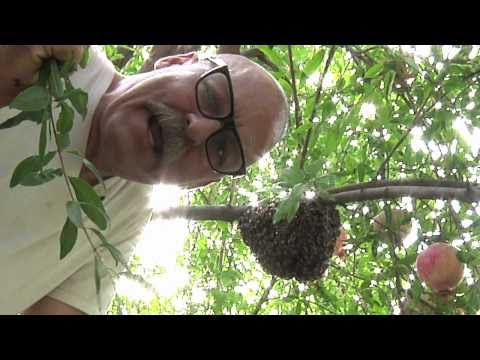
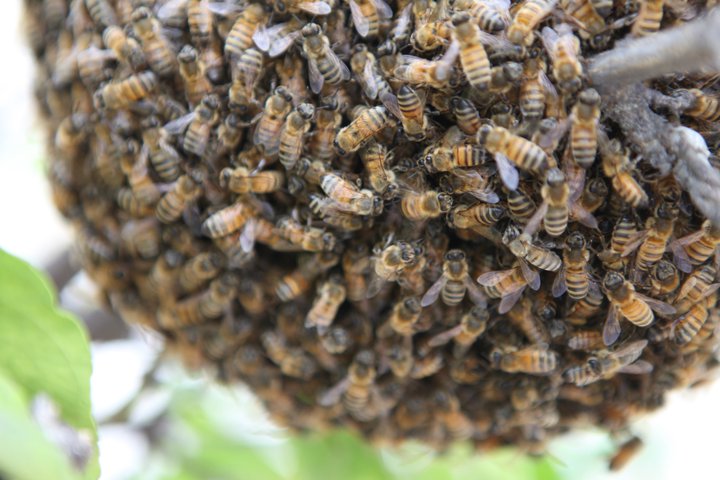
When I began beekeeping and reading about it, I was informed that the primary swarm emerging from a hive has the old queen with it. Afterswarms— the secondary or even tertiary smaller swarms that may leave later—are smaller and contain a virgin queen; or as it turns out, MORE THAN ONE VIRGIN! I was rescuing a swarm this summer that was on the tire of a car and it was was in two obvious lobes. Crawling in and out of the two parts were at least three queens. Surprise!

Josip Benko says these swarms with virgins are often a response to stress in the available food supply and occur in the Fall. One wonders how the bees manage this apparent lack of fealty to a particular queen, but Josip says they form something like “political parties,” guarding and surrounding the virgin they have attached themselves to. When the swarm takes flight, all leave together but travel with a factional group and when they come to rest, the factions stay somewhat apart. Regarding the swarm on the tire, by the time I actually came back in the evening to take the swarm, it had coalesced into one group and two dead virgins were lying on the ground. They must have taken to fighting for supremacy.

Another thing I am seeing and being called to rescue (and other beeks are reporting) is the arrival of VERY small swarms, often no bigger than an orange or a lemon. These little groups have such a bad chance of making it unless they can get hived with capped brood and capped honey in a container no larger than a 3 frame nuc. Again, these tiny swarms are a sign of colony stress and I have seen more than one clinging to a dead queen in a pathetic little bunch having lost the race. Our urban bees have a pretty rich source of nectar and pollen all year, but this time of year is still lean and so we beekeepers say it is a “dearth.”

Read full story · Posted in Newsletter Articles